

 Current position > Product detail
『Doppler Ultrasonic Flow Meter Working Principle: Multi-Phase Pipeline Sensing Basics』Related information(v cone flow meter|rotary gas meter|gallon meter|gear meter|metal tube rotameter|glass tube rotameter|nutating disk meter|transit time ultrasonic flow meter|wedge flow meter|pd meters|hydraulic flow meter|ultrasonic water flow meter|water flow meter|air flow meter|magnetic water flow meter|oxygen flow meter|gas flow meter|argon flow meter|air velocity meter|gasoline flow meter|fuel flow meter|ultrasonic water meter|digital water meter|nitrogen flow meter|solid flow meter|Oxygen tank flow meter|digital water flow meter|diesel fuel flow meter|steam flow meter|02 flow meter|compressed air flow meter|oil flow meter|liquid flow meter)
Doppler Ultrasonic Flow Meter Working Principle for Multi-Phase Pipeline Sensing
Quick Answer: A Doppler ultrasonic flow meter measures flow velocity by detecting the frequency shift of sound reflected off solids or gas bubbles in a moving liquid. It is a practical clamp-on meter for slurries, dredging lines, wastewater sludge, and crude oil with gas. For clean single-phase liquids, choose a transit-time ultrasonic flow meter or an electromagnetic flow meter instead.
How the Doppler Principle Works
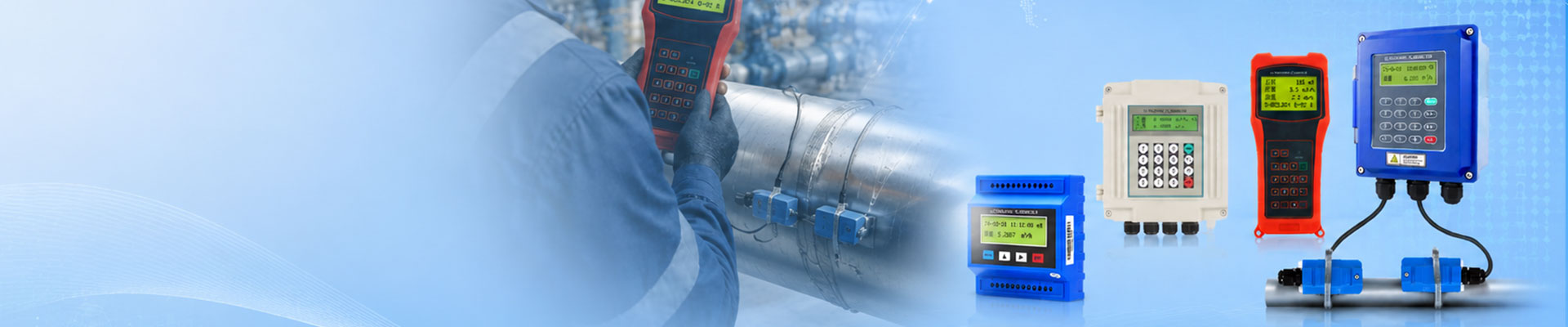
A clamp-on Doppler flow meter has two piezoelectric transducers. One transducer sends an ultrasonic beam through the pipe wall at a fixed frequency. The beam reflects off particles, fibers, or gas bubbles in the liquid. Because the liquid is moving, the reflected signal returns at a shifted frequency.
The frequency shift is proportional to flow velocity. The transmitter converts this shift into a velocity value. Then it multiplies velocity by the pipe cross-sectional area. The result is volumetric flow rate in m3/h, L/min, or GPM. Silver Automation Instruments supplies Doppler flow meters with local display and 4-20 mA HART output for this calculation.
A Doppler meter does not depend on clean fluid sound speed as much as a transit-time meter. This is why Doppler meters work in multi-phase applications where sound speed changes from batch to batch. But the fluid must have enough reflectors. In practice, a minimum solid concentration of around 100 ppm and particle size above 100 microns works for most models. We have seen stable readings on dredging slurry with 10 to 15 percent sand by volume.
Multi-Phase Pipeline Sensing Basics
Multi-phase flow means liquid with solids, liquid with gas bubbles, or liquid with both. Each phase affects the ultrasonic signal in a different way.
Slurries and sludge are common for Doppler meters. Examples include mining tailings, dredging lines, paper stock, and return activated sludge. The suspended solids reflect the signal well. A Doppler meter works without cutting the pipe or shutting down the process. That helps a lot on offshore platforms and remote pump stations in Southeast Asia or Latin America.
Liquid with gas bubbles also works, but only within limits. Small dispersed bubbles improve reflection. Large gas slugs cause signal loss. For horizontal pipes, mount the sensor on the side of the pipe. This avoids the gas layer at the top and the settled solids at the bottom. Avoid mounting on vertical downward flow with open discharge because the pipe may not stay full.
Crude oil with associated gas can be measured with a Doppler meter if the gas volume fraction stays below 10 percent. Above this level, velocity readings become unstable. For tough multi-phase separator outlets, we often propose a Coriolis mass flow meter or a vortex flow meter with pressure and temperature compensation.
Key Specifications for Field Selection
Selecting a Doppler ultrasonic flow meter starts with the pipe size and pipe material. Silver Automation Instruments is a flow meter manufacturer and supplier based in Nanjing, China. We offer clamp-on sensor sets for pipe diameters from DN15 to DN3000. The clamp-on design fits carbon steel, stainless steel, PVC, HDPE, and lined pipes. For concrete or heavily corroded pipe, an inline spool piece may be better.
Typical velocity range is 0.03 m/s to 12 m/s. Accuracy is around 2 percent of full scale. Repeatability is around 0.5 percent. Output options include 4-20 mA HART, pulse, and RS485 Modbus. Power supply can be 24 V DC or 85 to 265 V AC. Optional PT100 temperature input helps with heat metering or process monitoring. Harsh area models are available with ATEX Zone 1 or Zone 2 certification.
Here is the thing. Do not use Doppler for custody transfer. Use it for pump control, proces
Installation Tips That Most Engineers Skip
Most engineers skip the coupling step. A dry clamp-on sensor will not read correctly. Use the supplied coupling compound. For high temperature pipes above 120 °C, use high temperature coupling pads. Clean the pipe surface to bare metal. Remove paint, rust, and scale. Strap the sensor firmly with stainless steel bands.
Straight pipe run matters. Install the sensor at least 10 pipe diameters downstream from a pump or elbow. Keep 5 pipe diameters upstream of a valve or discharge. Do not install on a pipe that is only partially full. The ultrasonic signal cannot travel through air.
For wastewater sludge and slurry, signal strength can drift when the solid size changes. Calibrate on site with a known flow condition if possible. One customer in Vietnam used a Doppler clamp-on meter on a DN300 HDPE dredging line. The first install failed because the sensor was mounted on the top of the pipe. After moving it to the side, the signal strength jumped to 95 percent and the flow total matched the pump curve.
Recommended Silver Instruments Models
For general slurry and wastewater applications, choose a wall-mount Doppler flow meter with IP66 enclosure and 4-20 mA HART. For mobile audits or temporary measurement, choose a portable Doppler flow meter with rechargeable battery and data logger. For hazardous areas, select an ATEX Zone 1 version with flameproof transmitter housing.
If the liquid is clean or has low solids, a transit-time ultrasonic flow meter is the right product. If the liquid is conductive and has heavy solids, an electromagnetic flow meter handles abrasive flow with a ceramic or polyurethane liner. If the fluid is viscous, non-conductive, or requires mass flow, a Coriolis mass flow meter gives direct mass output in kg/h.
FAQ: Doppler Flow Meter Multi-Phase Pipeline Questions
Can a Doppler flow meter measure clean water? No. It needs reflectors. Use a transit-time ultrasonic flow meter for clean water, demineralized water, or treated effluent.
What is the difference between Doppler and transit-time ultrasonic meters? Doppler uses reflected frequency shift from particles or bubbles. Transit-time uses the difference in travel time between upstream and downstream signals. Transit-time needs clean liquids. Doppler needs particles or bubbles.
Can Doppler meters handle gas slugs in horizontal pipelines? Small dispersed bubbles are fine. Large gas slugs cause dropped readings. Mount the sensor on the side, not the top. Keep gas volume fraction below 10 percent for stable readings.
What outputs and certifications does Silver Automation Instruments offer? Standard output is 4-20 mA HART with optional RS485 Modbus and pulse. Certifications include ATEX Zone 1 and Zone 2. Power supply options are 24 V DC or 85 to 265 V AC.
Is a Doppler flow meter suitable for custody transfer? No. Use a Coriolis mass flow meter for custody transfer, invoice billing, or high accuracy mass balance. Doppler is for process monitoring and control.
Send us your pipe size (DN), fluid type, solid content (%), gas content (%), pressure (bar), temperature (°C), and flow range. We will recommend the right Doppler ultrasonic flow meter or an alternative technology and send a price estimate. Contact Silver Automation Instruments. Tel: +86-135-1213-1526. WhatsApp: 86-135-12131526. WeChat: +86 13512131526. Website: flow-meter.com.au