

 Current position > Product detail
『Duct Flow Meter: Commercial HVAC Ventilation Balancing Air Speed Anemometers』Related information(v cone flow meter|rotary gas meter|gallon meter|gear meter|metal tube rotameter|glass tube rotameter|nutating disk meter|transit time ultrasonic flow meter|wedge flow meter|pd meters|hydraulic flow meter|ultrasonic water flow meter|water flow meter|air flow meter|magnetic water flow meter|oxygen flow meter|gas flow meter|argon flow meter|air velocity meter|gasoline flow meter|fuel flow meter|ultrasonic water meter|digital water meter|nitrogen flow meter|solid flow meter|Oxygen tank flow meter|digital water flow meter|diesel fuel flow meter|steam flow meter|02 flow meter|compressed air flow meter|oil flow meter|liquid flow meter)

Duct Flow Meter: Commercial HVAC Ventilation Balancing Air Speed Anemometers
Quick Answer: For commercial HVAC ventilation balancing, a duct flow meter or hot wire air speed anemometer gives you direct air velocity and calculated air volume. Choose a thermal mass flow meter insertion probe or an averaging pitot tube with a 4-20 mA HART transmitter when the building management system needs continuous duct airflow data.
Why Duct Flow Measurement Differs from Pipe Flow Measurement
Duct airflow measurement is not the same as water or gas pipe flow measurement. Air density changes with temperature and altitude. Ducts are often rectangular, not round. The velocity profile in a duct is rarely flat. Most engineers skip this part and trust a single point reading. A single point reading works only when the duct has long straight runs and good flow conditioning.
In commercial HVAC jobs the goal is usually not laboratory accuracy. The goal is repeatable air volume data across supply and return fans, variable air volume boxes, and fresh air intakes. A duct flow meter that gives you m/s or m3/h directly saves time during balancing. Inline thermal mass flow meters for compressed air systems normally start at DN15. Duct probes are different because the duct itself is the flow body.
Air Speed Anemometers vs Duct Flow Meters in HVAC Work
A handheld hot wire air speed anemometer is the standard tool for a traverse. You drill small holes, take readings at multiple points, and average the velocity. That method is practical for commissioning and spot checks. We have seen this on a 45-storey mixed use tower in Singapore. The balancing team used hot wire anemometers for 14 air handling units. The job took three nights because each unit had multiple duct crossings.
A fixed duct flow meter gives the BMS a continuous 4-20 mA signal. In practice, contractors install a fixed meter after balancing is done. The meter monitors airflow to a kitchen exhaust or a laboratory supply fan. If velocity drops below a set point, the BMS raises an alarm. That is not a handheld job. That is a permanent instrument job.
Duct Flow Meter Options That Work
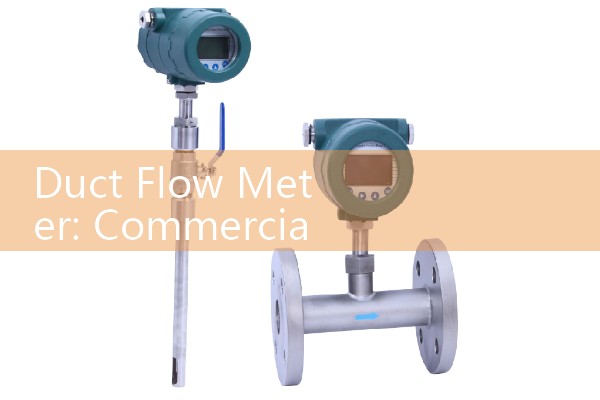
For most commercial HVAC ducts, four technologies are worth evaluating. A vane anemometer is low cost and works from about 0.5 m/s to 35 m/s. A vane anemometer is not ideal in dirty air because the bearing can wear. A hot wire anemometer is fast and sensitive from 0.1 m/s to 30 m/s. A hot wire anemometer is common for traverses but the sensor is fragile. A thermal mass flow meter insertion probe is rugged and outputs 4-20 mA HART. A thermal mass flow meter uses two RTD sensors, often PT100 class. One sensor is heated and one measures the air temperature. The probe works well in circular ducts from 150 mm to 1500 mm diameter. An averaging pitot tube with a differential pressure transmitter measures dynamic pressure across the duct and works well in large rectangular ducts.
For a 600 mm by 600 mm supply duct with air velocity between 2 m/s and 10 m/s, a thermal mass flow meter with a
Specifying a Duct Flow Meter Without Guesswork
Ask for these details before you quote. Duct width and height in mm. Air velocity range in m/s. Air temperature in °C. Signal output, usually 4-20 mA HART or Modbus RS485. Power supply, usually 24 VDC. Local display or no display. Installation type, insertion probe or flange mount.
Last year a contractor in Vietnam asked us for a duct flow meter to verify airflow in a hotel fresh air duct. The duct size was 800 mm by 500 mm. The velocity range was 3 m/s to 8 m/s. The BMS only accepted 4-20 mA HART. We proposed a thermal mass flow meter insertion probe with a 0 to 15 m/s range, a local display, and M20 cable entry. The contractor installed the probe in one morning. The signal matched the traverse readings within 4 percent.
Silver Instruments Support for HVAC Balancing Contractors
Silver Instruments supplies thermal mass flow meters, differential pressure transmitters, and paperless recorders for commercial HVAC projects. Our focus is fixed duct airflow measurement. Here is the thing. If you need a portable traverse tool, a good hot wire anemometer is fine. If you need permanent duct airflow monitoring for a BMS, we can help.
Send us your duct width in mm, duct height in mm, air velocity range in m/s, air temperature in °C, and required signal output. We will quote a thermal mass flow meter or differential pressure transmitter for your project. Contact Silver Instruments at Tel: +86-135-1213-1526, WhatsApp: 86-135-12131526, or WeChat: +86 13512131526. You can also visit flow-meter.com.au.
FAQ
Can a duct flow meter replace a handheld air speed anemometer on a commercial HVAC job?
Yes, when the building management system needs continuous airflow data. A handheld anemometer is still the right tool for a one-time traverse and balancing report.
What signal output should a duct flow meter have for BMS integration?
4-20 mA HART is the most common for HVAC. Some sites prefer Modbus RS485. Confirm with the controls contractor before ordering.
How do I convert duct air velocity to air volume?
Multiply the average velocity in m/s by the duct cross sectional area in m2. Then multiply by 3600 to get m3/h. If the duct is not round, use width times height for area.
Which duct flow meter works for a rectangular duct?
An averaging pitot tube with a differential pressure transmitter works well in large rectangular ducts. A thermal mass flow meter insertion probe also works if the probe length is correct for the duct width.
What accuracy can I expect from a thermal mass flow meter on a duct?
In these applications, the field accuracy is usually around 3 to 5 percent of reading after installation. Laboratory accuracy is tighter. In a real duct, velocity profile and probe position have more impact than the sensor specification.